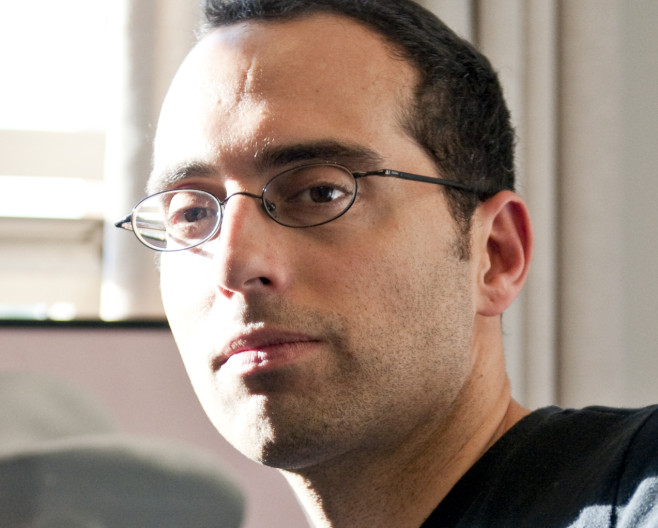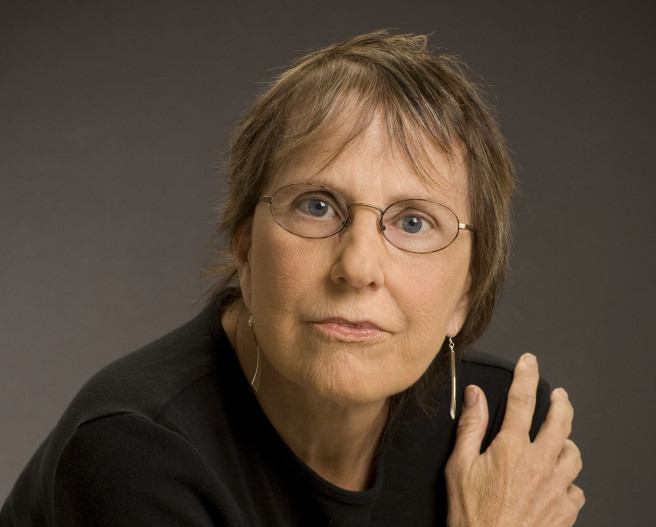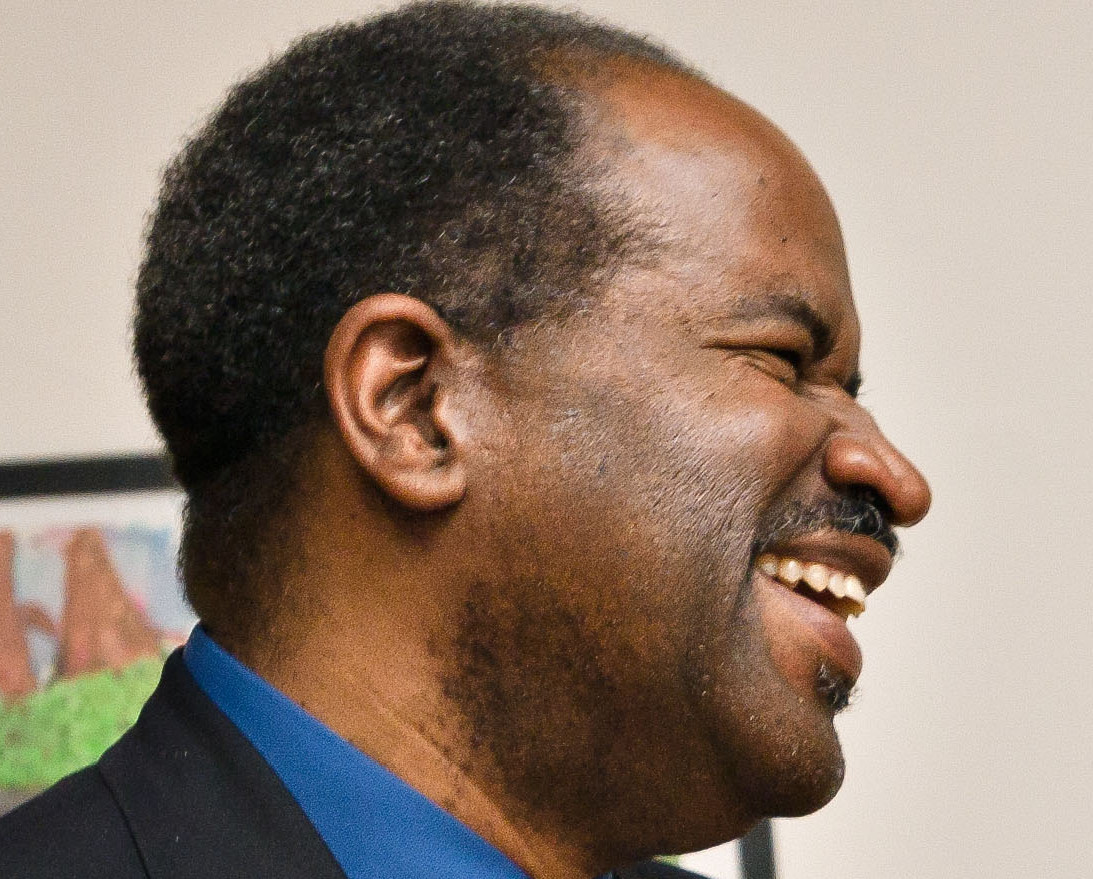
“Even my joy is ferocious.”
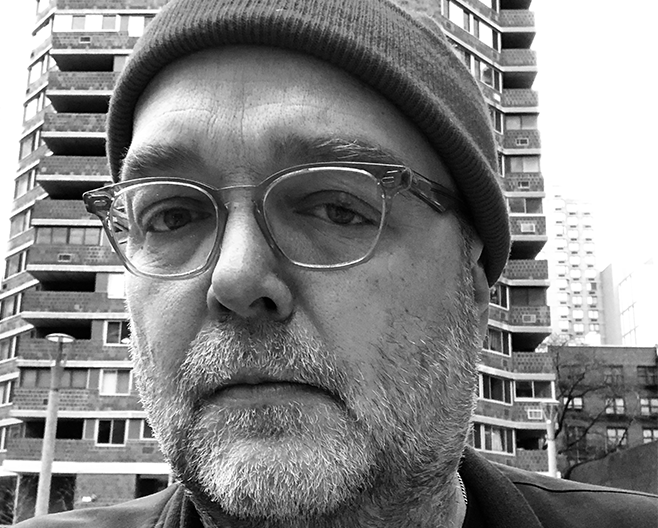
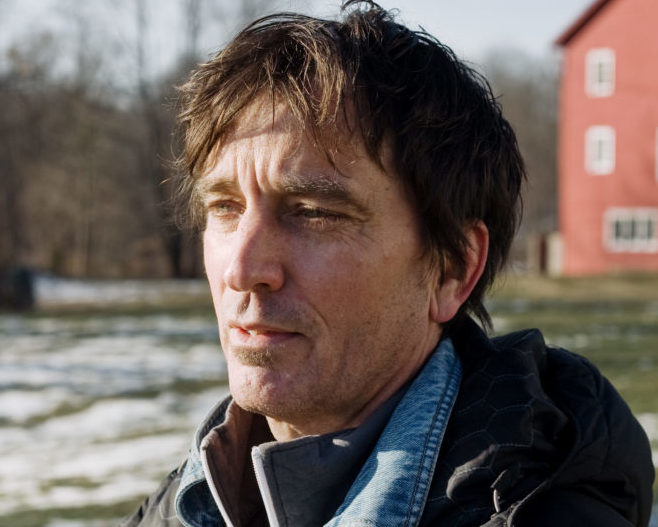
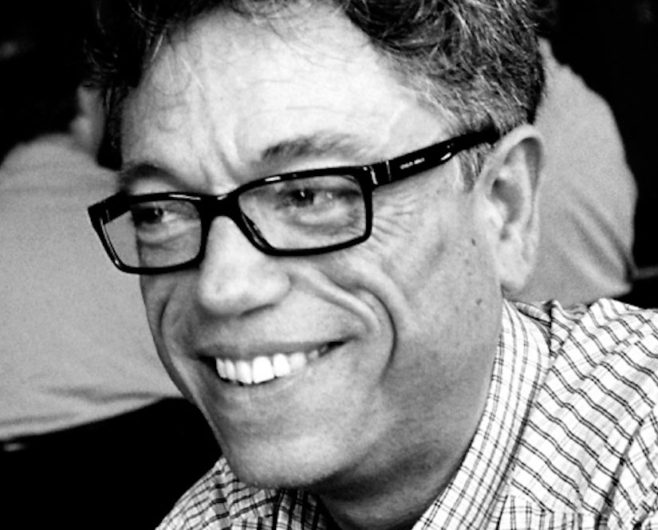
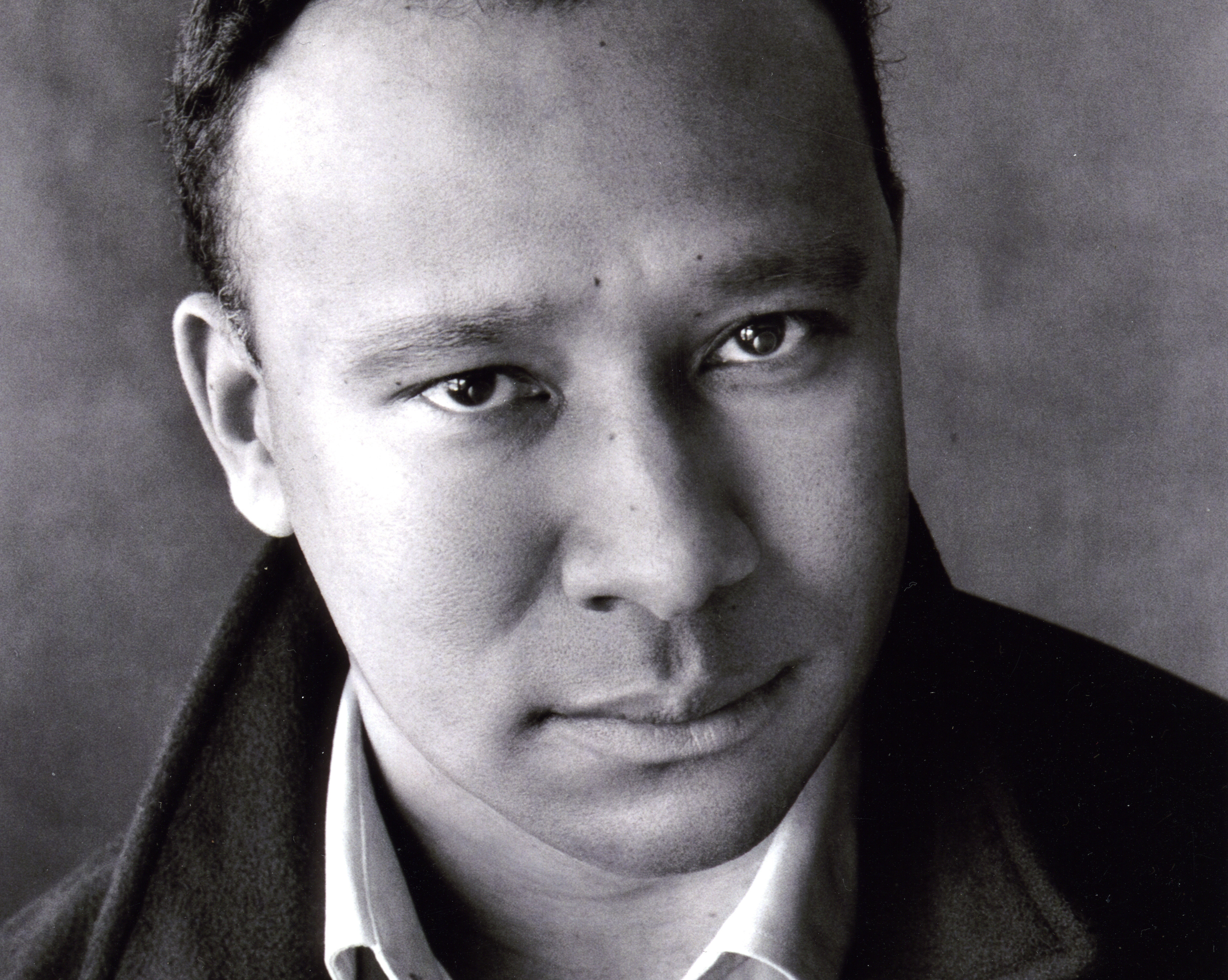
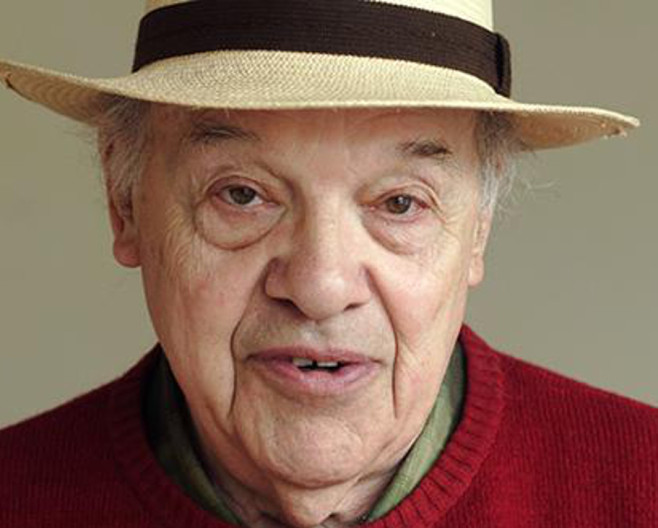
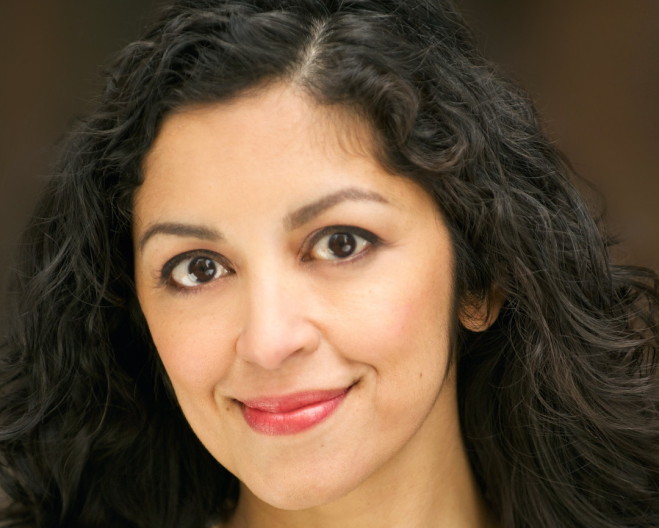
RICHARD SIKEN
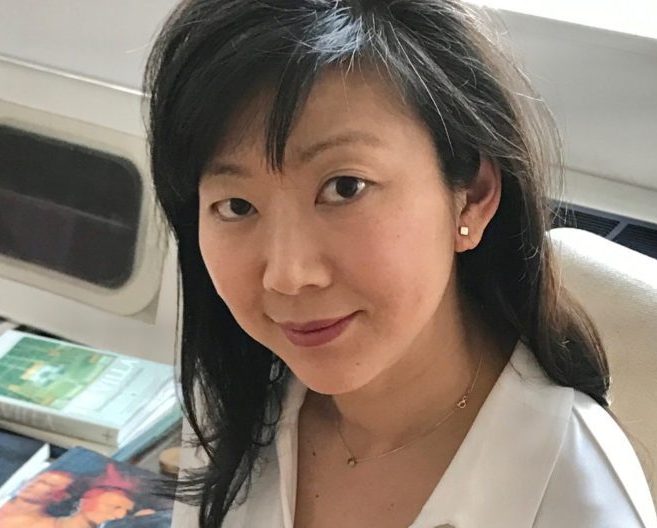
Interviewed By: Natalie Tombasco
I found this 2007 interview series where you asked poets (Thylias Moss, Jeanne Marie Beaumont, etc.) about their hobbies of collecting ephemera, memorabilia, and bones. Why and what do you collect?
It was great to have the opportunity to interview them. It was fascinating. Especially because I don’t collect things. Well, I guess I collect tools and materials—notebooks, fountain pens, paint and brushes, different kinds of tape and glues, things to bind books. I’m looking around my room. I have clothes, books, and computer stuff, but everything else is a material or a tool. Well, I guess the clothes and computer stuff are also tools. Someone once told me, “You can live as if your life is a museum or a studio.” They must have lived in a small apartment or had housemates, like me. You have to have space to have stuff. I wouldn’t mind that, but I’ve never had that kind of space. I asked my mom once what she would do if she owned the world. She said, “I don’t want to own the world because then I’d have to dust it.”
(Laughs) You know, when I asked the question, I toyed with the idea of starting a collection of some sort, but then immediately imagined myself cleaning around it. You’d also need many boxes and bubble wrap if you ever move. Seems like a big commitment, but I do like the idea of it, especially as it relates to poetry as a method of documentation. Jane Mead explains, “Poems preserve things in thought or image but not in reality. Maybe that gets back to the thing about wanting to protect and preserve; that impulse for preserving something in a poem might be in some ways similar to collecting.” Poetry magically resists both clutter and loss. What’s the difference between tools and collectables? Is a museum about preservation and a studio about possibility?
A studio is where you make art. A museum is where a curator selects and shows it. I think the difference between a tool and a collectable is that you’re not allowed to use the collectable, and you’re supposed to use the tool. I’ve also heard people make a similar distinction between arts and crafts: Art is useless, and craft is intended for use. The consequence of this idea is that everything broken (useless) is art. Perhaps that’s true, in a way. I think intention has a lot to do with it. You could argue that poetry is everything that isn’t conversation, that conversation isn’t heightened or framed, that its goal is simply the exchange of information. And the difference between a film and security camera footage? One has a director.
Figurative language is a purposeful distortion of the language. The bend away from the literal makes it artful, expressive. It’s language that moves sideways, that encourages lateral thinking. It celebrates possibility. Because it evokes instead of defines, some find it infuriating. Poetry suggests, it doesn’t explain. Its utility is suspect, debatable. “I am several kittens taped together.” Is that useful? My primary care physician doesn’t think so. In the world, everyone is frustrated with the poets. On the page, they think we’re profound. I say: don’t date poets, date painters instead. For sure, you shouldn’t live with them. Maybe you shouldn’t even be friends with them. Sometimes talking is overrated.
Oh, jeez—I married a poet, and we not only live together, but we co-edit this site! Thinking about collection as a hobby and how it’s a lifelong pursuit that requires a slow and steady accumulation of things, I wonder how that practice relates to your poetic process. You’ve noted that you’ve published “[a]bout sixty pages every ten years. I don’t want to waste anyone’s time.” How or why do you resist the pressures of capitalism to produce, produce, produce? Why are time and patience essential to your art?
Teaching pays. Arts administration pays. Sometimes editing pays. Publishing poetry doesn’t pay, so there’s no pressure to produce. There’s no pressure to do anything. It’s not that time or patience are essential; it’s that I throw a lot away. And from what’s left, I choose not to share. Writing is one thing, publishing is another. I write pretty much every day. I have since I was 16. That’s basically 365 pages times 43 years, which comes to 15,695 pages. I’ve published 219 of them. The job of a writer is to write. It isn’t to save or publish. That’s something else. The job of a singer is to sing. It isn’t to perform for others or record an album. The job of a plumber is to turn off the water and pull the pipes out of the walls. It isn’t to take you out to lunch.
So what’s essential? IDK. Curiosity is helpful. So is thinking. And encouragement is, well, encouraging. Time and patience, time and patience…. Let’s see if I can be less literal. There are two kinds of art: art that moves in space and art that moves in time. Painting, sculpture, and architecture move in space. Writing, music, film, and dance move in time. So I need time. In a way, it’s one of the materials. I shape time. I do it with dramatic beats and stressed syllables. I make rhythms and break them. I build sonic and thematic motifs. Suspense and surprise need time. Revelation needs time. And foreshadowing. Flow and restriction, tension and release, rising or falling action, all need time. Repetition makes us feel safe. Variation gets us excited. We need the shapes that move in time, the gestures. We need a reliable way of moving forward before we can transform or interrupt it. Without time, everything is frozen, static; there can be no development. Punctuation slows time. A linebreak is a hitch in the breath. A stanza break is a pause, a whole note rest. A dash builds anticipation in its little silence, its little leap of thought—it could land anywhere. I need time to write. I need time to read it out loud. Several times. I need time to let it sit quietly for a while before I return to it for revision. I need time to read and think, to experiment, to fail. I need time to experience things, consider them, and attempt an utterance. Time is the slow and steady accumulation of things. Patience is your attitude towards it. Patience is necessary for art only because patience is necessary for everything.
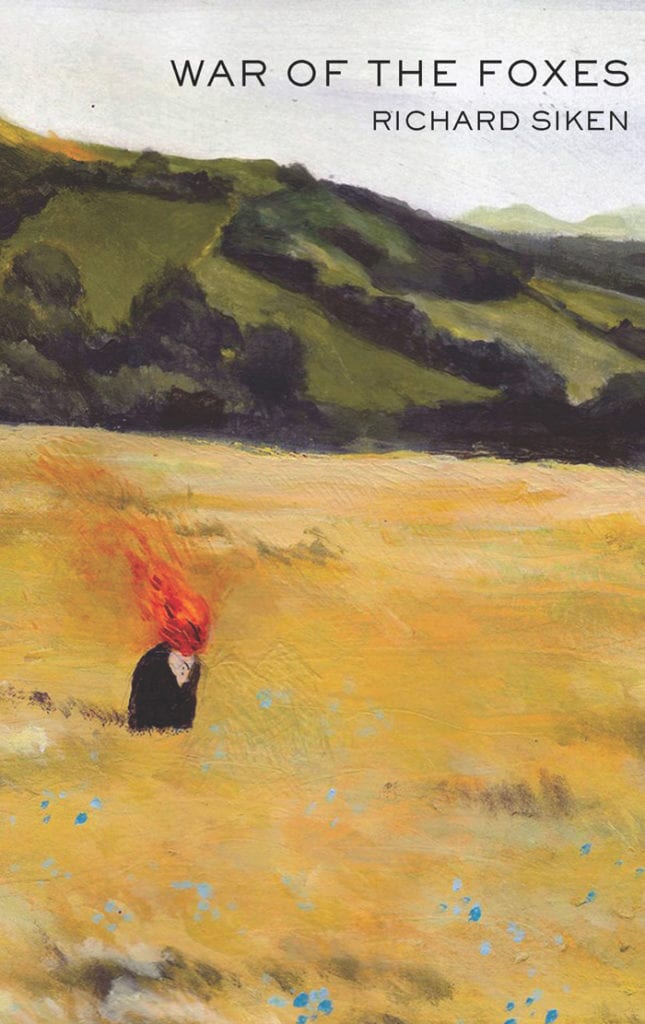
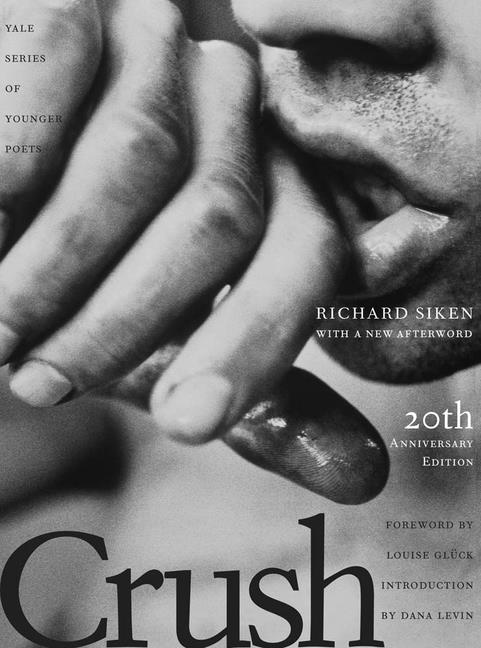
It’s true, accumulation is part of my process. I have notebooks so I can capture scraps of music, of thinking. I link up the parts or write into them. My revisions are often so extensive they look like a collage—parts struck out, revised parts glued over others. The scraps accumulate. The pages accumulate. The notebooks accumulate. My books are projects, rather than gatherings of poems. So themes accumulate, images recur, and concepts are returned to but from new perspectives. Things begin to resonate in their iterations. From Crush: “His hands keep turning into birds and / flying away from him. [...] Eventually the birds must land.” From War of the Foxes: “Why paint a bird? Why do anything at all?” and “I cut off my head and it turned / into birds. I called it thinking.” Also, there are the characters Bird 1 and Bird 2, which are basically the two hands that finally land to help tell the story. And all three books address the attempt to make a place, though in different ways. The new book, I Do Know Some Things, does so most explicitly and extensively. It starts with a poem titled “Real Estate,” and in a poem titled “Paragraph” that addresses the process of writing the book, there’s this: “I got everyone into the same room to see if something would happen. Something happened. [...] I built a house out of other houses. I stapled them together. It was makeshift but it kept the wind out.”
Your latest collection, I Do Know Some Things, a finalist for the National Book Award in 2025, has been described as a “backstage pass—” an autobiographical account of “what [you] can remember about [your] life.” The book centers on the stroke you experienced in 2019, particularly in poems like “Sidewalk,” which captures not only the terror of the medical emergency but also the indignities of the American healthcare system (worrying about ambulance costs, being misdiagnosed, apologizing for inconveniencing a friend). Even in the midst of this health crisis, there’s vulnerability and self-consciousness, as in “Metonymy,” where I, too, would be embarrassed by the handsome doctor. How did writing these poems shape your understanding of survival—not just physically, but emotionally—in the aftermath of something that “wasn’t going to unhappen?”
It’s common for books about disability to be told triumphantly and with hindsight. I didn’t want to do that. I also wasn’t sure that I’d recover. I wrote from inside the experience, not after it. I had a friend, a lifelong friend, who couldn’t deal with the situation. I still don’t know what happened—he won’t talk about it, he won’t talk to me—but he ran. I think he got scared and then later felt guilty. I’ll never know for sure, so that’s the story I’m going with. I think the worst part of the whole experience was the abandonment. I just needed him to say, “You’re going to be okay. We’re going to be okay.” I was actually okay with the idea of spending my life in a wheelchair. I wasn’t okay with being left alone in a wheelchair to figure it out by myself. I’ve survived many things, and I’ve always had to do it alone. I think I’ve cultivated a ferocity because of it. Even my joy is ferocious. Maybe even feral.
I’m not sure that writing the poems shaped my understanding; I think they slowly brought what was already there into clarity. I didn’t learn anything new; I just got clarity because I was focused on it. What I did learn about was language. I had to relearn how to make understandable sentences. I had to relearn how to link them together. I decided I would measure my recovery against my ability to make a followable paragraph. All the poems in the book are paragraphs. Four years after my stroke, those paragraphs still didn’t cohere. We pushed back the release date for the book twice because it wasn’t working. My editor at Copper Canyon Press, Michael Wiegers, had faith in me. I wonder if anyone else would have. I pulled it all together in the last few months.
Some things are too close to see. Louise Glück said my first book was about panic. I couldn’t see it. I was too deep in it. Someone once asked me why that book was so dark. I responded, “Dark? This is what the world is like. I want to know where you live. I want to live there.” I think this book is about survival more than recovery. I’m deep in it, so I don’t know what to say about it. I’ve got no conclusions. I can only describe what it was like to wrestle with the problems of trying to walk, trying to be understood. I’m trying to think if anything surprised me. I guess I was surprised that my will to survive was as strong as it was. I was determined to live, to walk again. I was determined to make sense again. I’m still not great at walking, and I tire easily. I have a cane. I have a stool in the kitchen so I can sit when I cook or do dishes. It’s not great, but it’s not so bad. And sometimes I forget a word or trail off, but it’s not so bad.
Love the idea of feral joy; not loving fair-weather friends. Yeah, it made me think how much we take our speech, our memories, and mobility for granted, as the speaker grows increasingly frustrated by language’s failure to communicate. In “Yardstick,” you write, “My memories were inaccurate and out of order. They did not accumulate….I had lost my poker face, my guile, and I was in danger of betraying my secrets and everyone else’s.” There’s danger in losing one’s filter. But there are also beautiful moments like in “Bed,” where the passing of time in the hospital is described through subtle shades, as you note, “The light moved through its stations: soft white, blur-white, buzz-white, white-white, cream-white, cream, tan, black.”
“The Waves” explores what you call “[t]he complicated mooring” as the imagination and language work in tandem to transport the speaker to Homer’s “wine-dark sea” in his journey to “recalibrate” the self. I found the hospital bed’s railings to be a hyperfixation throughout the book. They become this tangible anchor amid a drifting sense of identity: “I had forgotten the regular things I obsessed about—my favorite ugly places, where I would dwell endlessly: old wounds, slights, embarrassments.” How did shifting between imaginative escape and close attention to physical surroundings (in the WCW/thing kind of way) help you “reconstruct?” I’m also interested in your use of “recalibrate” and “reconstruct” in this context.
I had no memory or imagination in the weeks after my stroke, so everything was close attention to detail. Everything was beginner’s mind, locked in the present moment. I had no language. I went from words to phrases, then from sentences to paragraphs. Abstract thought came last. Imaginative escape came last. In “The Waves,” I was grasping at scraps of meaning. Certainly, there’s imagination in later poems, but here I am (the speaker is) lost: “Someone needs to knot the rope. Someone needs to finish it, a single thought completely. That it could follow. That there could be a rosy-fingered, wine-dark sea consequently breaking. I am the mermaids singing, twisted in the sheets.” It may seem like imagination, but it felt like frothing terror and confusion. I was reaching for meaning but only grabbing pieces of things I had memorized. It added to the confusion.
I think the reconstruction begins when I start to link words and concepts together, rather than getting lost in them. The remembered poems are mostly clear (though unreliable), but the in-the-present poems wrestle with the incomprehensible until I get a handle on some reliable information. I think the poem “Syllogism” is the first place where I’m truly getting imaginative escape: “A boy on a trampoline goes up and down, up and down in his invisible elevator. He is learning how to think about it. He is learning how to feel about it. His face is a newspaper. His heart is sweet candy. The forest is deep and wide.”
I think of reconstruction as rebuilding. I rebuilt language and memory and, I guess, a self. Recalibration is about adjusting, re-evaluating, fine-tuning. In “Devonian Forest,” there’s this part: “I planted sunflowers under the windows for my birthday. By summer they were tall as ghosts. [...] I said ghosts. They point, these nouns. They promise something. Poppyseed—His favorite dressing. Sunday mornings—I’m the one who ruined them.” I think that’s the recalibration—figuring out what the words mean and what they mean to me. Finding the commonality between my personal, private meaning and the agreed-upon meaning. That’s all about language, though. There was also the recalibration of self. For example, in “Field”: “Who you are and who you think you are: they grind against each other, sand in the frosting. I wanted to defend my new self from my old self. I didn’t want to be him anymore. You live on this side now. The thought crackled through the room. I sat, the stakes shifted, and the field split wide.”
Pulling from an autobiographical impulse, the poems wrestle with your childhood wounds, family lore, and fraught relationships. “Real Estate” reminds one after the death of a parent that “[t]hese things are complicated,” as many poems, such as “Driveway” and “Heart Valve,” consider haunted houses, property ownership, and inheritance. Many of the images pull from the domestic, from tablecloths to intercoms; “the light at the top of the stairs” in “Room Tone.” The opening poem’s final lines are strong-willed (“The dead will make room for me”) as they subvert much of the invisibility the speaker feels growing up adjacent to his stepbrothers in “Spoon.” How do you feel “Real Estate” sets readers up for what follows, and why was family an important subject to take on in your third book?
All three of my books circle a fundamental question: “How do I build a place where I can love you?” Crush focused on a lover, War of the Foxes focused on friends and enemies, I Do Know Some Things focuses on the self. The poems I’m working on now focus on groups, communities. The metaphor for this book is house. Every book of poems (usually) has a poem in it that teaches you how to read it. This book has several: “Real Estate,” “Landmark,” “The List,” and “Paragraph” especially. The book starts with the impossibility of selling a condominium and ends with the successful sale of it. Each of the seven sections happens in a different house on the path of my recovery: condo, hospital, rehab, guesthouse, house with a housemate, imaginary houses, and the house of the book being written. Sure, the book is about family, but I think the family is there in the service of the house. Many poems are not about family, but the house is still there. (From “Patty Melt”: “I was still in a wheelchair when my mother died. I had her cremated. There was nowhere to put the box.” From “Cover Story”: “A few hours later, a friend called and told me. He suggested I break into the apartment and start removing things before the family arrived.” From “Yardstick”: “I jumped from house to house, through iterations of myself. My memories were inaccurate and out of order. They did not accumulate.”)
Almost every poem is about a house or a proxy for a house: a restaurant, a hotel, a hospital, a grave. And the prose poem paragraphs themselves are houses, rooms, boxes. The poem “Paragraph” is about the construction of the book itself: “I didn’t know what to do with it so I put it in a box. I tried to keep it all together but it was multiplicitous, in theory and practice....I built a house out of other houses. I stapled them together. It was makeshift but it kept the wind out. I sat in each room until I could describe it. I adjusted the furniture….You can put words around anything, even an absence.”
It’s fascinating how the book is hyper-focused on language and craft: subjunctives, tenses, parataxis, voltas. “Line,” “Sentence,” and “Paragraph” were so hypnotizing to witness how the mind moves. Your chosen form reminds me of this Charles Simic quote: “Prose poetry is a monster-child of two incompatible impulses, one which wants to tell a story and another, equally powerful, which wants to freeze an image, or a bit of language, for our scrutiny.” I think the structure illustrates the containment of the house imagery, but also the graves and parking lots in “Patty Melt”: “Some people think that parking lots are like the open sea but really, there are rules.”
I’d like to turn to another element of craft if we can. “History” is wildly associative, finding connections through artistic and scientific discoveries. “Piano Lesson” begins with an imaginary friend who played viola, but it spirals out on a lineage of musical instruments that are both beautiful and violent: “If a harp lay down and fell asleep and you bludgeon its dreams with felted hammers then you would have a piano. If you were wearing a tuxedo, you would have a grand piano.” You have explained, “We talk about associative leaps in poetry. We don’t talk about associative landings. You have to stick the landing.” What’s your approach to leaps and landings? Is there a particular poem or bit of craft advice that’s guided you?
Okay, let’s do a close reading of “Piano Lesson” to chart the leaps and lands. The goal is to stick the landing. To get there, you need a setup. A volleyball metaphor: the association is the set, and the conclusion is the spike. In the poem, there are three things to track: 1) The musical instruments. 2) The artificial body. 3) Transformation. This poem is not a memory poem, and it is not a recovery poem. It is from the third set of poems: the hypotheses. The memory poems are the past. The recovery poems are the present. The hypothetical poems are outside of time. They could be alternate times or even the future.
This book is concerned with the body. One of the main questions of the book is “What is a body and how do you live in one?” This poem is an investigation of the body as an instrument. The conclusions are: 1) Imaginary bodies are hollow. 2) We want to be what we are not. 3) The body can continue its work, even when the hands are finished.
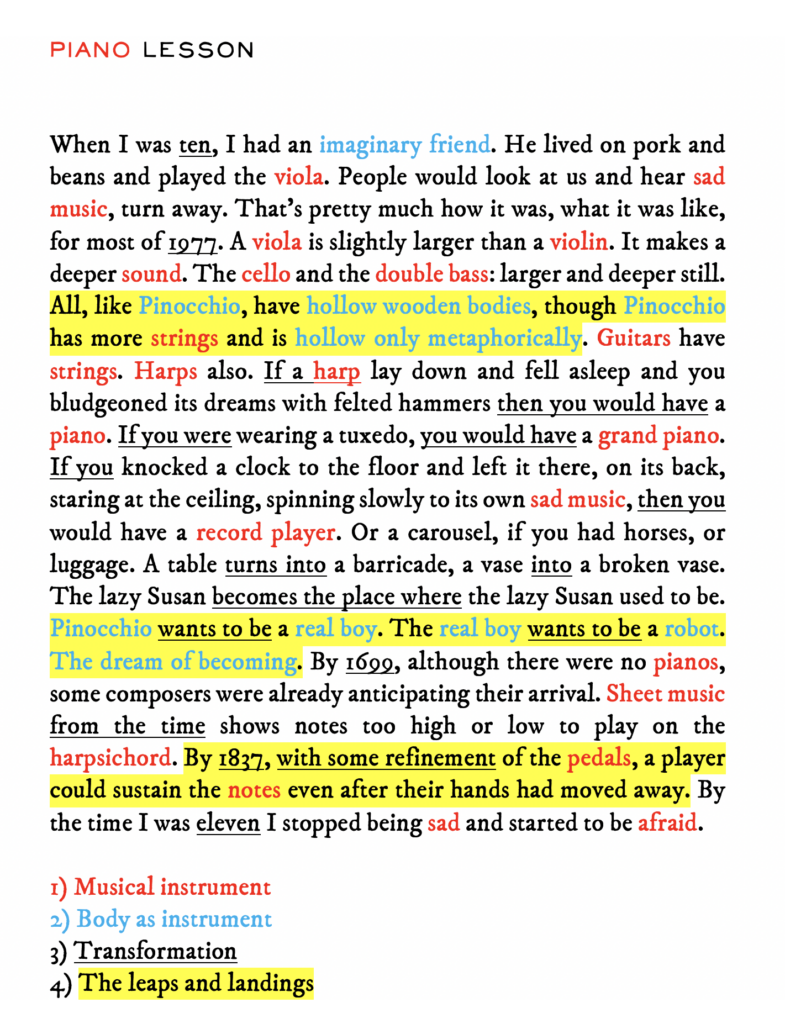
The first thing to track is the musical instruments. They are little landings. The poem can hinge away in any direction, but it stays contained by the repeated return to the musical instruments. The words for the musical instruments are colored red. Visually, you can see how they make stepping stones through the poem. The first big leap/land is the comparison of Pinocchio to a musical instrument. It relies on the connection of a stringed instrument to a stringed marionette. Pinocchio is a pivot. He is the body as an instrument. His proxies are the imaginary friend, the piano, the robot, the lazy Susan. Those comparisons are little conceptual leaps. So the second thing to track is the artificial body. Those terms and concepts are colored blue. The second big leap/land is where Pinocchio returns and wants to be a real boy. It’s where the word want appears. These inanimate things have some animation and agency: the instruments make noise, the piano dreams, Pinocchio desires. Even the lazy Susan has a name and an attitude. The “dream of becoming—” of animating—is supported by the little lands of transformation. The if/then and the becoming are underlined. They are also repeated several times. The ages and dates also count as transformations. The third big leap/land is the effect of the piano pedals. They allow the sound/song of the instrument—the animation of the instrument—to continue after the hands have left the instrument, implying continued animation for Pinocchio after the hands leave the strings.
In an even larger sense of leaps and lands, there are the later poems, where a robot and a ventriloquist’s dummy will also be compared to empty bodies. The idea of an imaginary friend returns in the poem “Spoon.” And the clock, knocked to the floor and left on its back, staring at the ceiling, will be the speaker in the poem “Velocity.”
So, the associations aren’t random. There were scores of associations that occurred to me while writing this poem. I only kept the ones that were in the service of the argument, of the investigation. It would have been easy enough to go on for pages about everything that occurred to me. The goal wasn’t to associate wildly for the sake of it; the goal was compression and cohesion. You need a goal when you’re writing. You need to know why and how you’re doing the things you’re doing. Random thoughts don’t always accumulate in interesting or powerful ways. For me, the strategy of leaping and landing lets me structure my wide-ranging notions and asides into something focused and intentional.
Oh, wow. Thanks for breaking that all down. I suppose Pinocchio also connects to the speaker who wrestles between truth and fiction throughout the book.
Okay, last question! You’ve said in relation to audience that “[t]he poet, like the onion, does not care who cries.” Readers often find Crush during formative moments in their lives—first love, a breakup, an unexpected loss. There are Tumblr tattoos, Spotify playlists, and it’s described as a “gateway drug to poetry,” speaking to its cultural impact and power. However, in the new edition’s afterword, you explain how it’s often been stripped of its original contexts among ever-changing political and social environments, and even used among Twilight and Supernatural fandoms. In “Cover Story,” you revisit the relationship in Crush, which I found to be a devastating poem in how the queer speaker must remain distant and hidden even in times of grief. After twenty years, I wonder how you feel about the book becoming an emotional companion for so many, how your relationship with the audience has evolved, and why it was important for you to return to this story and correct the record.
Well, this was a book about reconstructing a self out of authentic parts. I had never told the story of how my boyfriend died; I had only shared the poems I had made out of the grief of losing him. I figured it was time to engage with the true story and see what I could make of it. The poems in this book have a range of emotional distance—from raw, unintelligible lyric bursts to dispassionate narrative exposition. This poem, “Cover Story,” is probably the most emotionally removed. I wanted the weight of it to rest on the content, not the reaction. In Crush, the story is tragic, epic. Here, I wanted to tell the true story as gently as I could. I wanted a few precise moments to be the means of conveyance. I think the entirety of I Do Know Some Things corrects the record. It even puts things on the record that were never addressed before.
All writers are confronted by this question: “Would you rather have a book that’s fixed in its time or one that evolves as the times change?” In 1990, a queer person remaining hidden in a time of grief was a given. In 2026, the idea that one might need to hide is foreign. It doesn’t occur to a young reader. When it was written—in the 1990s, during the AIDS crisis—the poems in Crush were located in the understanding that blood and sex equaled death. New readers in 2026 don’t share that context. I think they’re missing out on some of the meanings. But new readers still find Crush relevant. For that to happen, the context has had to change with the times. Also, it’s been 30 years since I first started writing the poems in Crush. I’m not 29 anymore, I’m 59. In a way, today’s readers are closer to the content in ways I no longer am.
My relationship with my audience is complicated and fraught. This is mostly because I make myself available and I engage with them. I’m on Twitter, and I answer all questions I’m asked. They don’t always like the answers. There have been several fights, meltdowns, and parasocial interactions. There’s a lot to be said about the Death of the Author, but it’s hard to believe in when the author is on Twitter, arguing with you. I figured rather than answering your question, I’d ask them what our relationship was like. Most of them responded to me about our online interactions, rather than as writer and reader, but here’s some of what they said:
“late night talk radio show host + the sort of hot messes who call into late night radio talk shows”
“blunt but affectionate office hours.”
“i think a lot of people interact with you as a poet as a higher authority. I think in a rather unrealistic and unhelpful way but people want you to have the answers”
“without the hemlock, we hope!”
“Pretty good. Your writing has helped me connect with my humanity, and you will answer questions I have about craft, which is something I can’t say about any other poets I deeply respect (outside of friends, former teachers).”
“a curmudgeonly mentor figure who gives me tough love advice that i sometimes resent the accuracy of”
“ur like a slightly agitated grandfather to me”
“you’re like a bitter old uncle who possessed a soft heart in his youth but nobody cared about his existence. he tried practicing self love but ended up confusing it with narcissism.”
“As a poet and reader, our relationship is that of someone that shows us it’s okay to express emotions. As a twitter audience, I would say our relationship is slightly parasocial and a little misunderstood, and like that of an elder yelling at kids to do better and be better.”
“I would describe our relationship as committed”
“It’s like peanut butter pretzels”
“i hope not parasocial”
“extremely parasocial. the concept of Richard Siken, Poet was much more of an idealized figure before your audience found out that you’re also Richard Siken, Man With Opinions And Differing Life Experience. and i mean that with all respect towards both you and them.”
“a lot of your audience only saw you as the citation at the end of a quote that they could apply to the fictional relationships they’re passionate about, and I think it was a shock for them to find out that you’re a real person”
And then there was this multi-post response:
“People want a story. They build ideas in their minds that expand beyond the page in foundation, and Twitter especially presents a conundrum: it is difficult to act as a ‘person’ without inadvertently becoming a ‘concept’, and it is difficult to become a ‘concept’ not unfairly elevated and distorted, or lowered and maimed. This is not to say that popular creatives should not be criticized, or that every criticism or adulation falls into one of those two categories, but rather that—again, at least from my eyes, the vulnerable medium you specialize in finds itself at odds with your very understandable wish to maintain some sense of distance and professionalism with us. I think that most of your readers understand that you are not their friend, and/or that you are not the personas through which you write. Twitter, though, lends itself to a certain demographic, which might explain the odd hyper-concentration of outliers you’ve found yourself interacting with at times.”
So, that’s some of what they think. Sometimes I think to myself, “How strange to be living in a time when Richard Siken is writing.” Richard Siken has become something that even I’m an audience of. “Who am I? I’m just a writer. I write things down. I walk through your dreams and invent the future.” That’s from Crush. That’s what I do, what all writers do. Some find it comforting, some find it confrontational. Still, underneath it all, there’s always the central desire: that I could write something worthy of a reader’s attention, and that they would attempt to understand where I’m coming from. A simple enough goal, in theory.
Interview Posted: May 26, 2026
MORE FROM DIVEDAPPER. (Drag left)