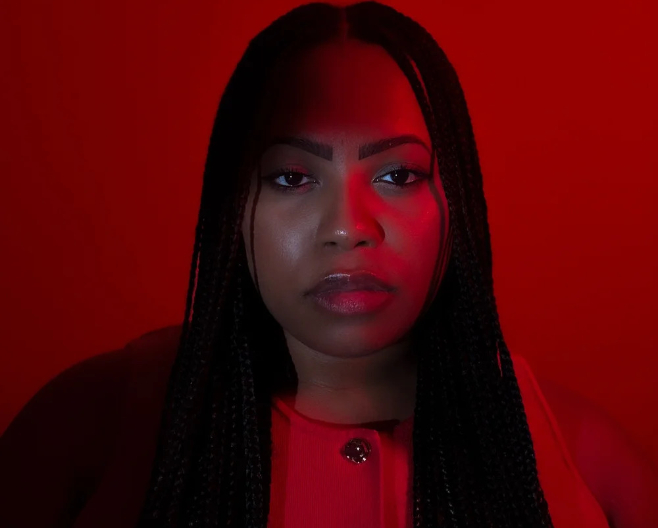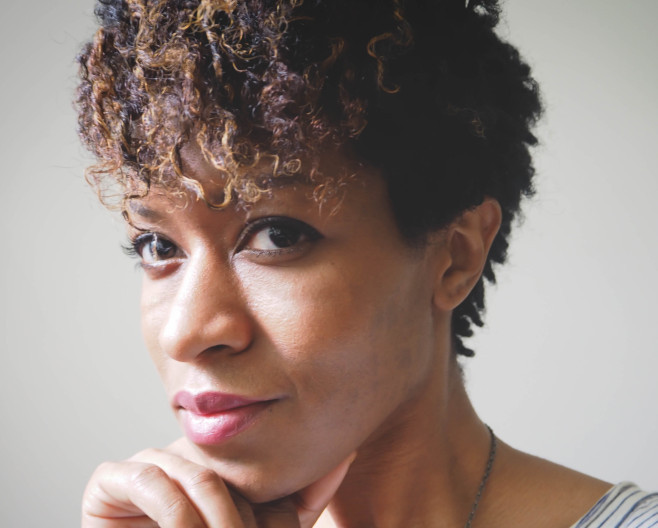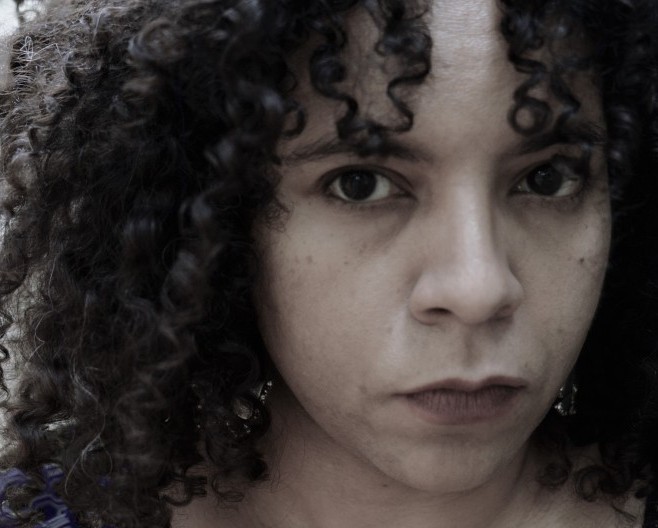
“Stone-faced at the world. ”
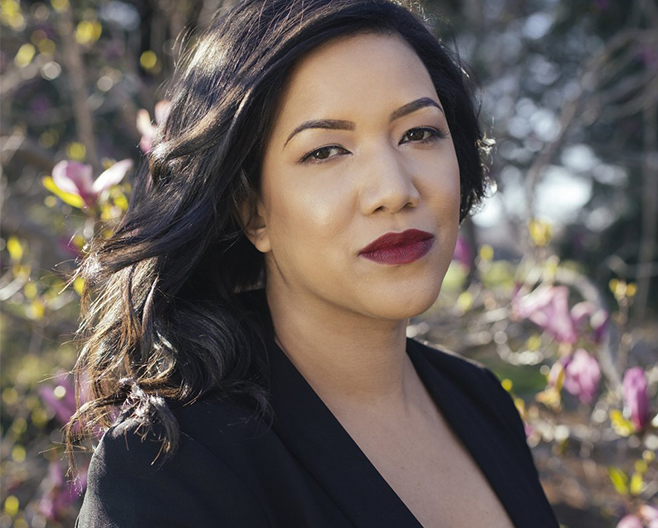
TAYLOR BYAS
Interviewed By: Natalie Tombasco
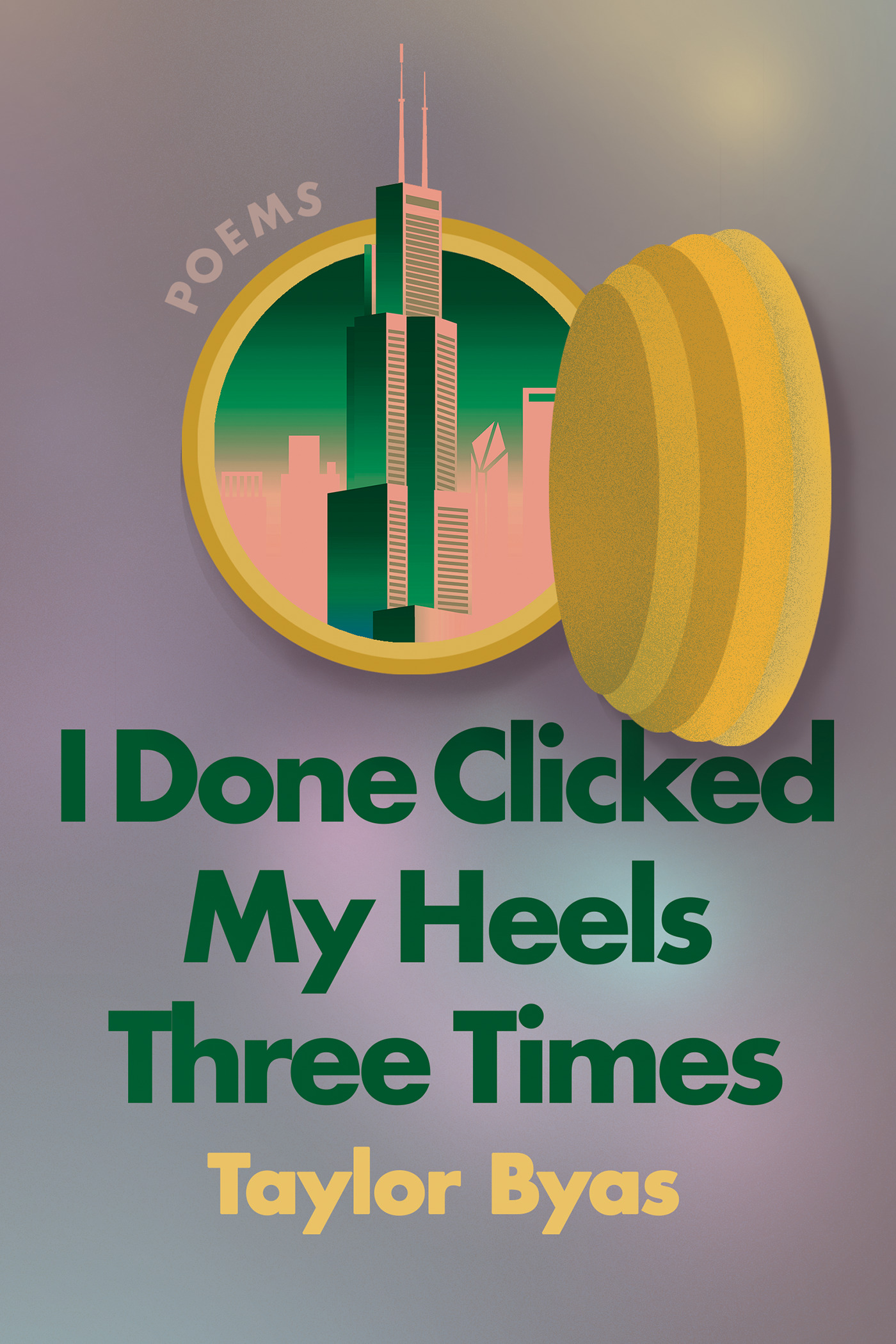
I Done Clicked My Heels Three Times encouraged me to think about “home” in this abstract sense: What and where is it? Is it a place to hang your hat? Is it the first city you’ve lived in alone? Is it tethered to you like the moon? Is it found in a person? There’s something imprecise and impermanent about the idea of “home.” The collection travels from Chicago to Birmingham to Cincinnati on this yellow-brick journey of self-discovery and self-love, underscored in the final line: “I’m still learning.” What are your thoughts on place and home?
Yeah, I love the word “impermanent” because while I was writing these poems, I was physically away from my hometown, Chicago. That distance and clarity allowed me to realize how Chicago shaped me. I was a grown-up growing away from this place that raised me. I went away to college in Birmingham, and gone through a lot during those years—difficult relationships, heartbreak, and just learning how the world is extremely painful as a young Black woman. Cincinnati is a place where the city itself is progressive and liberal, but the state has these political issues that make you question how safe you can feel. The book is very much about self-discovery. What does it look like to find or build a home away from what would be traditionally considered home? Ultimately, the poems were a space to consider what it means to move through this world as a Black woman.
You’ve said, “Chicago was my third Black parent, always saying ‘I brought you into this world and I can take you out.’” The poetic landscape you construct isn’t the technicolor-dream-world of Oz, but instead, the real-life Chicago—its brownstones, streets, and churches.
Right.
Explored in poems like “You from ‘Chiraq’?,” one of the book’s aims is to subvert right-wing media perceptions of Chicago as a war zone. I was reminded of Hanif Abdurraqib’s essay “Chance the Rapper’s Golden Year,” where he writes, “To turn your eye back on the community you love and articulate it for the entire world that may not understand it as you do. That feels like freedom because you are the one who controls the language of your time and your people.” Eve L. Ewing has also written about Chicago, specifically the systemic racism and inequality of the public school system. Why was it important to write about the Windy City?
There are two extremes to that portrayal—this violent kind of wasteland and the technicolor dreamscape. I think both of those sort of exaggerations can be harmful in different ways.
Mm-hmm.
Just like any other city, Chicago has its complexities, its pros and its cons, its personalities. It has differences depending on where you are. I’ve encountered both extremes. In Birmingham, I think, because it’s further away, a lot of people stick to the general negative connotation. When I moved to Cincinnati, many people either lived in or visited Chicago, and so their perception of the city is limited, like “I went on this really gorgeous trip, and it was magical,” and that’s their entire understanding of it. I felt like if I was going to write about this complicated place that feels like a human subject, a character, I was dedicated to portraying a full range of the joy it’s brought me, the nostalgia, the balance—the cold winters, hot summers.
The wonderful thing that started to happen is when people came to the book, they learned about Chicago, and then they connected it to a place, a city, they knew. We write and make art for many reasons, but one of the reasons is to build connections—to remind others that we are never as different as we think. It was a gift to show the complexity of Chicago, and for readers to find pieces of themselves, their homes, in the book.
Yes, and Chicago kind of acts as a microcosm for how urban places across America are perceived. This is more of an observation on your poem, “Corner Store,” where there were “Older men who gummed out baby girl, with smoke / and corn chip breath they offered like candy.” That detail makes me want to puke, but it gets at this depressing and universal reality of girlhood where one gets sexually harassed at the neighborhood deli, bodega, or Walmart. I certainly remember having Cheeto-dusted fingers and being like, “Can’t just pick up my Little Debbie and be on my way, sir?”
No, never. Never!
One reviewer employs the term “misogynoir” for the presence of sexual violence normalized in “The Early Teachings,” where religious instruction to dress modestly is given: “Because the boys may be tempted by your flesh, / your safety is your responsibility.” Violence is passed down from mother to daughter like “family heirlooms,” and conflated with desire when older women advise the speaker, “Oh honey. He didn’t know better. You have to show them / the way.” She learns early on that boys are blameless.
I think a major part of Black girlhood and Black childhood is the way that a child is portrayed as older than they are, or forced to be adults much sooner than they are, whether that’s in the familial home, on a societal level, or in the media. One thing that characterizes my work across both books is a desire to create productive discomfort. You know, that image that makes you squeamish, that particular smell of corn chips. Creating those moments of discomfort is central and heightened. The voices and sensory details the girl-child focuses on are juxtaposed with the creepy adult man.
Another poem along this track is “Men Really Be Menning” which runs the gamut on dating in the twenty-first century, sketching characters who exude “crotch-grab cockiness,” insincerity, and emotional unavailability. Round and round on the loop of disappointments! It was funny when Tinder Guy asked, “Girl, what that mouth do?” I thought, “Read poems!”
Yes!
That might be Tinder Guy’s worst nightmare, I think…. You create a soundtrack for this book with mention of the grandmother’s piano, songs from The Wiz scaffolding the sections, “Da’ Dip” serving as a nostalgic club anthem, and Beyoncé’s “Hold Up” aligning with the speaker’s frustration with and revenge on her love life. Can you share the role of music in your life and how that translates to poetry writing?
Music is healing for me, so for this first book, it was something I leaned on. It felt very vulnerable, putting it together, and thinking about it going out into the world. I was writing about my father and a lot of personal family dynamics. My father has all the capabilities to read the things that I’ve written about him.
Has he?
I remember I wrote an essay about him a long time ago, and our relationship had been strained at that point. This was well before the book came out. There was a time when I went to his house, and I saw the essay printed out, sitting on the dining room table, and I was like, “That feels a little extreme, but okay.” There was that added layer of anxiety and stress about this collection being published, but music was extremely healing and calming throughout the process.
Thinking about the literal influence of the book, The Wiz is a musical, where throughout the story, songs serve as transitions and interludes to the beginning of a new chapter. Music is an opportunity for characters to pause and reflect, express something, or let the viewer into some sort of internal process. That thinking bled into the collection. If I were to do a one-woman play, I’d have traditional pieces in there, Beyoncé would probably make an appearance…. I’ve always had a low-grade obsession with how music shows up in Black women’s poetry.
Yes, well, I feel like some of my earliest experiences with poetry were actually just like looking at the Genius website and interpreting song lyrics.
Wow, what a time! They had the little interpretations for you. It was like SparkNotes for music.
Yeah, the early days of literary analysis. Okay, random, but do you have a favorite Beyoncé album?
No, this is great. I had a recent debate about this. I’m very much team I Am… Sasha Fierce.
Oh, interesting. I feel like that one taught me persona and performance like Sasha Fierce is Lady Lazarus in a way, and you have the duality or split-personality between the two albums….
My life was changed by that album. I’m obsessed with it.
Returning to the book, I loved that transformative image of “our backyard’s weeping willow is really a woman / with microbraids.” In “Tender-Headed,” we find this bonding moment and ritual of a girl getting her hair braided by her grandmother, and while this is an act of care and nurturing, there’s pain in the process and a meditation on Black ancestry: “I strain / against her grip on my roots….She hums ‘For Your Glory,’/ parts my hair into sections, / gridding out old city streets / and rows of cotton.” And then, of course, this is juxtaposed with this Worldstar spectacle in “This Kill Bill Scene Has Me Thinking About Weave and Girl-Fights,” where sisterhood is exchanged for credibility. Can you discuss the role of hair and the tension between vulnerability and violence?
One of the most vulnerable things you can do, especially as a Black girl or woman, is let someone touch or style your hair. You are quite literally sitting in front of someone with your back to them, neck exposed. There are so many things that can go wrong. Trust is essential. Talking about hair as a Black woman writer is something I’ve seen done often. This isn’t a knock in any way, shape, or form. It’s an important part of our culture and identity. For me, a challenge was asking, “How do I make this fresh?” The Kill Bill poem was one approach. I am a lover of crisis; that is my jam. So, there’s that startling image of her hair flipping through the air that stuck with me. It was one of those aha moments—a door to talk about something central to Black womanhood and girlhood.
Your second collection, Resting Bitch Face, shifts slightly from the autobiographical and place-driven poems from the debut. In terms of space, it settles into museum galleries, movie theaters, dark rooms, and art studios as a fixation on various artistic mediums and the notion of subjectivity. The section titles highlight materiality and process (“Canvas,” “Gesso,” “Dry Down,” and “Signature”), while the poems interrogate the relationship between artist and muse, the power of the gaze, and how the female body is objectified. There are sculpture studies, Y2K-style nude selfies in the “Nikon COOLPIX S210,” apertures, mirrors, and family photo albums. Can you discuss how the poems developed in this book, and why you decided to focus more on art for this project?
It started with my obsessions. One day, I woke up and picked a handful of paintings to respond to. As I started to write about the artists, who they were as people began to bleed into my interpretations. At the time, I was working on my dissertation, and thinking about how the intersection of scholarship and artistic world, the academic and personal, can coexist. I was thinking about minorities engaging with scholarship, specifically art history and art criticism, and how the personal and poetic ones can inform these academic modes.
There’s a litany of ekphrastics on work by Pablo Picasso, Sally Mann, Eric Gill, Nan Goldin, René Magritte, and Paul Gauguin. Can you offer the narrative behind a couple of these and why you gravitated towards them? What did you want to reveal?
I return to Sally Mann because I remember a conversation in the college classroom about how controversial those photographs were. The book explores the ways that women and girls are objectified, and here you have an image a mother has taken of her own child, and as it was going out into the world, where it could take on this completely different meaning, right? She loses control over how it’s interpreted, which happens to all art when it enters the world. There’s only so much that we can control. To think about this moment between mother and daughter, or to capture this innocent scene of family life, and how that gets chewed up and turned into something else. That felt central to the book’s concerns.
With Picasso, I explored these famous artists with problematic personal histories. In “The Red Armchair,” I was struck by the subject’s two faces, especially knowing that he was violent. I could not let go of that. I was thinking about a woman being slapped in her face, facing one way, and then facing another. I reached for a sonnet because I needed sonnets when I’m overwhelmed and need to figure out what’s happening. Sonnets help get to the heart of something.
It’s interesting you mentioned the two faces because I wanted to think about the expression of the Resting Bitch Face—the “sacred side-eye.” It speaks to the tough exterior in the Chiraq poem, but also how women are expected to smile, providing ease and comfort to men. We’re expected to open ourselves and “peel back” for strangers; never look serious, disgruntled, etc. You point out that smiles are faked like orgasms in “A Woman to Woman with Mona.” Regardless of the performance of pleasentry, you write, “Smiling has never brought me tenderness, never tendered me a love that let my face be bitch, and ain’t that what you gon’ call me anyways?” I love these lines because it’s like, “Let’s just cut to the chase and get this over with.”
The poem, “Resting Bitch Face,” came first and was situated in the middle of the book like a heartbeat. It came into being during the pandemic, as I was going through the world wearing a mask. I noticed men stopped commenting on my face and saying, “You should smile.”
Sure.
I was thinking about that annoying policing of how we’re supposed to present ourselves at all times, even when we’re just going about our business or trying to exist. I thought about how the term “resting bitch face” has been weaponized, which is the idea that someone says you don’t look friendly or approachable enough. No one ever comments on how pissed off men look. I mean, have you ever looked at them? They look pretty pissed off with the world, and no one is barking up their tree, telling them to smile.
Over time, the book’s speaker gets feistier and more assertive as it progresses. I wanted there to be a transformation of our understanding of the term. There’s our initial understanding of the phrase, maybe someone has used it on you before, but by the end of the book, I wanted it to feel like this intentional act of being unbothered—not engaging or not giving someone the satisfaction of your reaction, or your vulnerability. Stone-faced at the world.
Similar to Gwendolyn Brooks and other Black formalists, you reach for sestinas, erasures, pantoums, haibuns. The South Side sequence is a crown of sonnets that enacts the ideas of home discussed earlier—leaving home, returning to it. The form demands that we look backward as we’re being propelled forward. Each sonnet feels like a stop on the “L” train, bringing us into a past scene. You write, “it’s sensory, / the act of remembering, of making memory.” How are received forms conducive to your process?
Forms help me figure out what I need; my need dictates the form. It’s symbiotic. In my master’s program, I had a professor who had a formal boot camp over the summer. Every week, I was assigned a form with additional crazy rules. I liked the puzzling challenge of figuring it out.
That’s where my love began. I spent time thinking about Black women’s poetic traditions, and how there’s a question of canon, and who is legitimized as a formalist. Remembering my own education, and the lack of formal poems by Black people using language familiar to me about experiences that matter to me. Like Shakespeare, love you—very important. But also, what were you talking about? What about generations younger than me that might have an interest in poetry and form? If I were feeling that way about Shakespeare, they’re feeling it times ten. They don’t see themselves reflected in what they’re being taught. As a lover of form, this is why I teach it and what it offers young writers.
You’ve mentioned your enjoyment of “formal torture,” which reminds me of Imani Davis’s poem “Kink.”
Oh, I mean, incredible. Yes.
The predetermined restraints of form are compared to “aesthetic and erotic pleasure.” I find this true in your poetics as well—how there’s a surrendering to the poem that requires more intimacy, more truth-telling.
To contrast that notion of surrendering, I want to think about resistance and how that appears in your writing across genres. I understand that through your doctoral studies, you focused on writers like Audre Lorde, bell hooks, and others, so I’m wondering which texts were most instructive to you, and which recurring ideas did you slip into the back pocket to work through yourself? How do you see your poems fitting into the Black female poetic tradition?
Hmm. The book Spill by Alexis Pauline Gumbs is very central. I pulled the epigraph for the poem “Resting Bitch Face” from that work (“how did you get here? what trumped-up troupe of slave-ship sloop put you here on my doorstep in your nastiness”). Thinking about scenes of fugitivity was very helpful and informative. Claudia Rankine and Patricia Smith were essential reading, too.
Your essay “Excavating My Voice After PhD Exams” really resonated with me with its discussion of burnout, brain fog, and how the process is sort of a pleasure-zap for reading and writing poems. Finding that joy again is an active process. Can you speak to the challenging, humbling, and rewarding experiences of surviving “the program?”
A creative writing program is an environment of different perspectives and voices that shape your writing. In those environments, you start to figure out what you really care about. Presenting your vulnerabilities to a classroom of people to give feedback is where things get prickly. You could become defensive, but that’s where you start figuring out what matters to you. Those moments are helpful and instructive. A creative writing program, a doctoral program, nonetheless, is not the only place that you can get that experience.
What happens when you leave the program, after being accustomed to those voices in the classroom or in your assigned reading lists? The challenge then becomes finding your own voice. That takes time. I gave up on the idea of writing a solid draft for a while, and once I took that pressure off and just read what I wanted, then I started to hear myself again. I reconfigured my voice. Being in those environments is helpful because you get a glimpse of everyone’s journey, but then that’s the dangerous thing about social media. We can mistake people’s curated, selective experiences—the awards they’ve won—but not the 100 rejections they received before getting that one acceptance.
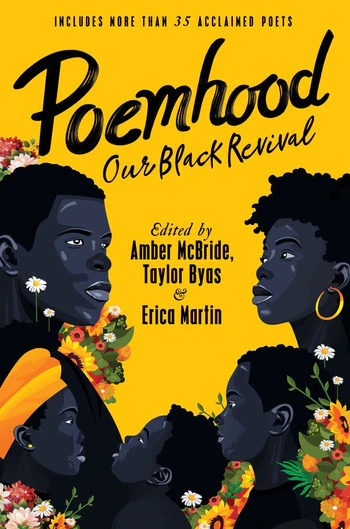
To end on a pretty cool educational project of yours, I’m hoping you can discuss the editorial goals for this young adult and restorative anthology, Poemhood: Our Black Revival. How are the themes “Livin’,” “Gawd,” “Haunting Water,” and “Magickal,” working as an organizational principle? How do you think a collection like this would serve your younger self?
Oh, great question. One reason why Amber, Erica, and I came together for this anthology was in reflection on what we were taught in school. You learn everybody else’s mythology, but there’s rarely anything about Black folklore. We wanted to fill that educational gap with poetry. I would have loved to have stories of Black folklore taught alongside Greek mythology, because you tend to recognize similarities across time and place. We’ve narrativized our lives across cultures. It would have done a lot for my younger self. For the young readers who are finding it, I hope they discover these similarities across cultures and stories. There is something mythical and magical about the way that children see the world that we lose as adults. We lose our imaginations. Kids must see their own lives and their own people—and that magic exists for them. It has existed for them for a very, very long time.
Interview Posted: April 28, 2026


MORE FROM DIVEDAPPER. (Drag left)