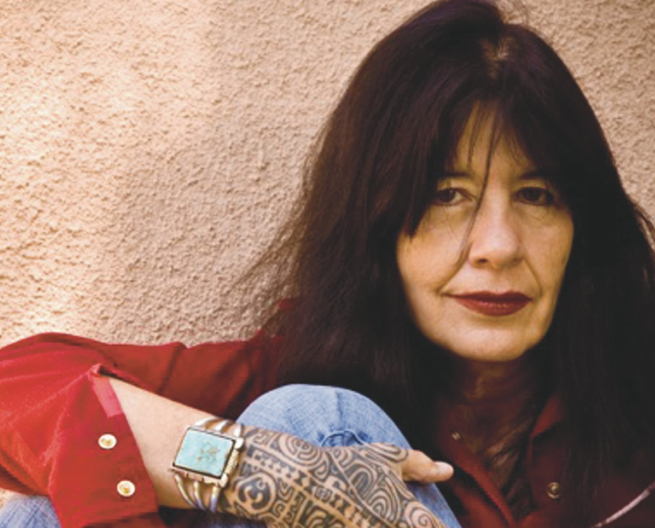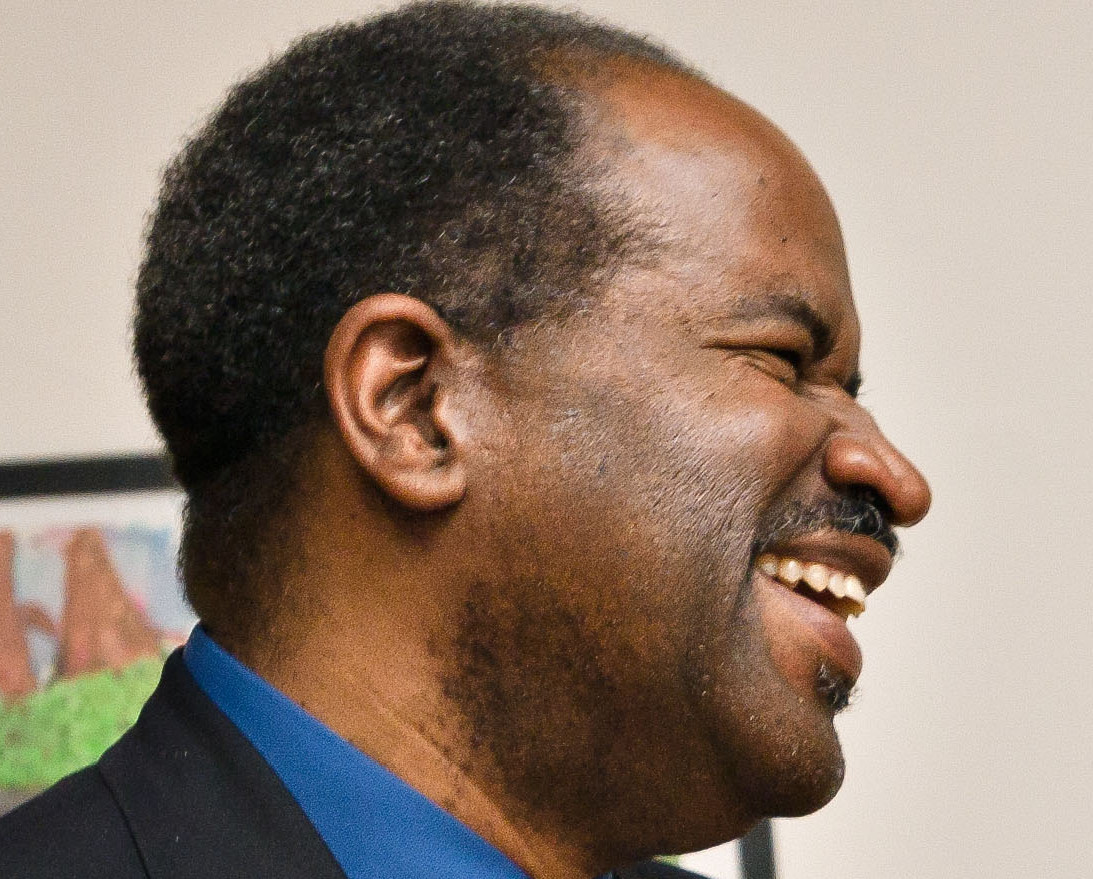
“It is about soul language, soul talk.”
JOY HARJO
Interviewed By: Anthony Borruso
I recently listened to an interview you did with Rachel Martin on her podcast Wild Card, which had a really cool format where she was shuffling around cards and asking randomized questions.
Oh, yes, that was fun.
You talked about attending high school at the Institute of American Indian Arts (IAIA) in New Mexico and how it was a formative experience for you as both an artist and a young person. You said, “I felt I was in my place,” and that it was pivotal for understanding the power and context of your own voice. From there, I know you went on to study at the University of New Mexico and then received your MFA at the prestigious University of Iowa Writers Workshop. Can you talk about the difference between these institutions? What do you feel you took away from each?
Yeah, I was a high school student at the Institute of American Indian Arts; now it’s a premier arts college with low residency programs, including one in creative writing. We had excellent arts teachers, Native and non-Native. But that school freed me in so many ways. I was away from home drama and repression, not by my mother, but by my stepfather, and I felt free. It really helped to be in classrooms with just Native students. It was the first time I would even talk in class.
You weren’t so outgoing at that time?
No, and probably not even until a few years ago.
And at that point, you were doing visual art, right? You shifted to poetry a little later.
Yes, I almost got sent to Chilocco Indian School, but when we were leaving the agent’s office, my mother said she’s a really good artist, and he said, “Well, here,” and handed her a pamphlet on the Institute of American Indian Arts, so I applied based on my drawings and got in. I actually graduated a year early from IAIA because I had enough credits, which helped out because I became a teenage mother. And then I went to the University of New Mexico a few years later and started my first semester pre-med.
Okay.
In my second semester I was back in studio art, and I was working towards a BFA degree in art. I was there at a time when a lot of the Native poets were coming in. I met Leslie Silko, Simon Ortiz and James Welch. So I got to be around all those poets and hear Native poetry, and started writing. It took me over, and I changed my major from painting to writing.
And I realized the other day that I started writing poetry around the time my daughter came into being. In ’73, I think I had my first poems published. She passed a couple of years ago, which was the hardest thing, and this book, of course, honors her.
Yeah, I was so sorry to hear that. The way you talk about her in the book is really beautiful and also heartbreaking.
Yeah, so I realized the other day that I started painting again about a year ago. I thought, “Wow, that’s kind of interesting.” The cover of Cloud Runner, you know, is my work.
Oh, that’s your painting!
Yeah, that’s my art on the cover.
Wow, it’s really great.
But yeah, later I taught at the Institute of American Indian Arts. And teaching there is so different from other institutions. I felt free. I still hear from a lot of those students who comment on my teaching and my teaching style. From there, I got into Iowa.
So you’re going from a Native space to a primarily white, probably more male space at that point, too. Was this a big transition for you?
Definitely. In fact, when I had arrived there, they brought four of the graduate students: Jane Ann Phillips, me, and two guys, poetry and fiction, for a short program and fundraising meeting with people who might give money, and Jack Leggett, the director of the program at the time, got up and said, “Yeah, this is a program for male writers.” He actually said that. And I remember elbowing Jane Ann, saying, “Jane, did you hear that? You are a witness. So what are we doing here?”
Eek. Very different time.
Yeah, it was different. I don’t say I was coddled; I worked my butt off, but I went from Native-centered spaces to a place that was not. But I had gained friends there. I’ve been lifelong friends with Sandra Cisneros. And I was part of the Chicano Indian Center. There were only 7 Native students in the whole school. But I learned a lot there. It was important for me to go there, even though it was very, very different from living in a community in which you knew people, people knew you. And even education-wise, many of the students in that program had PhDs in American or British literature. I came there mainly as a young painter who had started writing poetry, and it was difficult for a lot of reasons, but I realized that even the students that I thought had everything were going through some of the same issues. In any graduate program, you have students at the precipice of becoming. It’s setting the stage, so to speak, for your life and your career. I think graduate school is a testing place for everyone
For sure, definitely.
Do you feel like they pushed you in a more formally rigorous direction while you were there? Did the school match your poetic style as someone who is intuitive and doesn’t always adhere to traditional forms?
Not really (laughs). And even Marvin Bell, when I became U.S. poet laureate, he wrote me, and I still have it here somewhere in my collections. He wrote me a note and basically said, "We didn’t do much for you at Iowa.” And I agreed with him, “No,” but it was important I spent time there.
Yeah, sometimes you just got to battle against the other side or explore other poetic temperaments.
Yeah, I mean, I could argue for being a formalist if I was from another culture or tradition. I have distinctly not foregrounded classic tropes. I’m familiar with them, things like Greek myths and so on, but… and I have noticed, this is way back, I noticed that a lot of people who weren’t European would often use those. They would open a door into attention by the academy because they think, “okay, you know this stuff, so you can come in here.”
Yeah.
I deliberately didn’t do that. Which wasn’t helpful. I don’t think I’ve been the best promoter, and that seems to be in the foreground now. You know, with social media comes promoting, but for me, poetry is about something very, very different. It is about soul language, soul talk. And yes, there are formalities. But even then, soul talk doesn’t mean you’re all over the place, or you just write whatever you feel. There’s structure. You have to have architecture. I think of a poem like building a house. If you get a wrong line in there that doesn’t fit, it would be like having a two-by-four just sticking out for no reason, you know what I mean?
Yeah, for sure. Maybe part of the reason that you write the way you do is that, early on in your career, you said that you thought of yourself as more of an activist than a poet. After all the recognition and institutional support of your work, do you think your activism has changed or evolved in any way? Do you think having been a poet laureate and attaining this status has been something that’s helped your advocacy work?
It surprised me, the attention it brought. Being U.S. poet laureate, it’s an honor, and I totally didn’t expect it. I realized when my term was over, and I did three terms, that it was a relief to step out of the spotlight, like somebody had lifted something away.
It was Ada Limon that followed you as poet laureate, right?
Yes, Ada followed me.
Did you have any advice for her when she took over? Did you give her a poet laureate pep talk?
I’m trying to remember. I think I did. She did write to me a few times because it’s overwhelming. But one thing I noticed about my terms is that Native people were thrilled. Because it’s an honor; it was an honor for everybody, for Native people, and for poets who didn’t write like everybody else.
Yeah, oh, that’s cool.
I really love your signature project as poet laureate, which was creating an interactive map of Native Nations’ poets called Living Nations, Living Words. It was such a beautiful way to spotlight Native poets and capture the regions and geographical features that shaped their voices and their language. What was it like working on this project?
During my orientation at the Library of Congress, I visited the Geography Department, and I thought it would be cool to make a map of Native poets. I wanted people to know that there were a lot of Native poets. And my original idea was to highlight every one of them. Everybody! And put them on the site where people could explore the map of the U.S. according to the Native writers. Well, the guy in geography—anything he did for my project was added to his workload. It would have been a lot of work and still nearly impossible to include everybody. We didn’t have the time or the human power.
That’s tough.
Yes, it would have been, because in my vision, the next part would be to put all the American poets up and show our connections, because we are all connected. It’s like a genealogy of poets. What I used to do sometimes when I would teach poetry is have the students bring in their favorite poet, and then ask why, and who did they admire, and then look at that poet’s ancestors, and read everyone in that circle of connection. They would create their own genealogy of poetry ancestors.
That’s a great exercise! Like, just work your way backwards to the earliest American poets.
Everybody would have their own study guide, share it in the classroom.
That’s interesting. I’m wondering, could you do that for yourself? Who do you see in your poetic lineage? Emily Dickinson would be one of the poets I’d put up there.
Yeah, there are so many, and then I discover more. It’s like digging around genealogy. I really like Charles Bukowski, too, and he was a misogynist and all of that, but when I was first starting to write, I was reading him, too, and I was reading Pablo Neruda and Auden.
Oh, yeah.
People that you read, they’re all a part of it. Even Walt Whitman, who was a little bit of a misogynist. I think probably every American poet and poem goes back to, or in some way has a nod to, Emily Dickinson and/or to Walt Whitman. Which is part of the genetic flavor, so to speak.
Reading your latest collection, there are certain symbols that, whenever I see them, I tend to tie them to Dickinson, like all the doors that show up because she was always transforming domestic objects like doors, windows, closets.
Interesting, I didn’t know there were so many doors. I know I get into these patterns of repeating words. There was a time when it was “worlds.” I had “worlds” everywhere, so I stopped using that. And then “beautiful.” One book, even my editor, Jill Bialoski, got onto me about that. “Doors” might be the new one….I’ll have to look at “doors.”
Yeah, well, there are doors that appear in “Red Dawn Song,” “Eat,” “With Praise For The Poet,” and a few other places. They seem to be a metaphor for death, life, or any transition. Or, in “Overwhelm” it acts as a barricade when there is “a door between the men arguing and me.” But you can also feel Dickinson’s presence in the ways you subvert smallness, and your reference to a “feathered hope” in “With Praise For The Poet.”
That makes sense. Yeah.
And I couldn’t help but think of Dickinson writing past form to the edges of her consciousness, her “Plank in Reason,” when your poem “On The Stairs” talks about the poet living in the “deep down outskirts / of unmeasured eternity.” Which, I love how that line captures the poet’s desire to sprawl wildly and move inward at once. So I saw these little crumbs of Emily as I went through the collection.
That poem was really written on the stairs!
And it’s funny how they wind up there. It’s sort of like when you watch grandchildren or great-grandchildren, and you see those little references, and they can be just gestures or something from somebody they would never have met, like a great-grandparent. And then you see it.
Maybe we can talk more about Cloud Runner, your newest collection of poems, which that piece comes from. It’s a poignant and heart-wrenching book that attempts to put words to an unspeakable loss, the loss of a daughter. Before we say more about it, I just want to offer my condolences and tell you how much I appreciate this book for its unflinching look at grief and its faith that poetry can provide refuge even in our harshest moments. In Kevin Young’s introduction to his anthology of elegies, The Art of Losing: Poems of Grief and Healing, he writes, “No one wants to write an elegy. I presume we simply must, the death of someone dear—or even a stranger—calling forth words that fail to explain, but sometimes provide our only comfort.” The opening lyric of your collection, “This Is Not a Poem, It Is a Cry,” brought me back to Young’s quote with its simple yet devastating opening, its short end-stopped sentences, declaring: “I have lost my girl. / Some things do not belong in words. / There is a sacred unspeakable story.” We can feel the struggle of writing these lines, the tension between their simplicity and the overwhelming hurt they try to contain. And yet this is also a piece of hope in which you call on relatives with wings and “clouds carrying ancestral rain [to] bear her up.” Later, you assert, “she will make it home.” Can you talk about this opening poem and writing through the wordlessness of grief?
Yes, I don’t know how I’m going to read that poem in public or if I will ever read it. Because I wrote it four days after she passed. I didn’t sit down or say, “I’m going to write a poem.” I just wrote.
So there’s just this overflow of feeling.
I mean, it’s edited. I edit the heck out of everything. But it was still within that raw grief when there are no words for us, especially when a child passes. That’s not how it's supposed to happen.
Yeah, you can sense that. Throughout the whole book, there’s that feeling of rawness. Not that it hasn’t been painstakingly crafted and worked through, but that you are being emotionally vulnerable and open with the reader.
I think that’s what provoked it. I remember I was leaving New Mexico, and thinking, where would I ever find her again? And poetry works, or words work, to make a pathway. The grief—where does the grief go? How does it go? What does it look like? It’s always shifting and moving, and it approaches you at different times and places on its own terms, and you just have to deal with it.
Being beyond language is such an important part of that poem. There’s a line that states, “Reason has no home in this hour.” But then your collection has these unspeakably joyful moments, too, where you’re thinking about nursing your daughter and the beauty of having a child and showing her the world. There are so many places where you struggle to transcend language.
Right, as a poet, I feel like I’m always working towards wordlessness. That’s the great irony, or even paradox of poetry: that you use words to get to wordlessness.
One of your epigraphs took me to wordlessness. It was by Katie Bickham: “Grief is like contractions, but in reverse.” Which, the more I think about it, the more profound it seems to me. Like your book, it illustrates how intermingled life and death are, how they both are initiated by labor and pain, one leading into the world, the other out of it. On another level, though, it made me consider how the reverse of “contraction” is “expansion” and the way your book describes death as returning to an ancestral collective, a spirit world with its own “cloud language.” Rather than being birthed into an individual, one becomes a part of everything. Why did Bickham’s quote feel like a necessary gateway into the book for you?
I just saw her too. She was a student of mine at Stonecoast’s Low Residency MFA. It was wonderful. I called her up, and I got to hand her one of those copies. She was excited.
Oh, that’s awesome. She must have really loved that.
I like what you were saying: that the opposite is expansion, but then expansion is giving birth, too, in a way. I guess what I would say is that the doorway that a child comes through is the same doorway that we leave by. And that’s how I see it. It's that same doorway.
Since this is a book that thinks so much about mortality, I was wondering, are there any other writers or thinkers who’ve helped you work through your thoughts on mortality and its dual nature?
I love Ed Hirsch. His book Gabriel: A Poem, about his son Gabriel, was wild and difficult and wonderful, all at once. Yeah, that poem. He had written to me about something, and I said, “Sorry, I haven’t responded. I lost my daughter. He wrote back and said, “Welcome to the saddest club in the world.”
Yeah, yeah.
A mother and a daughter—it could be one of the most difficult relationships; like, she cut me no slack ever. But we were bound.
I love the way you capture her headstrong nature when you say, “She was never one for following another– / Not even her mother.” That was a really poignant moment.
You celebrate motherhood more broadly too. You depict the mother as a kind of alchemist who can take different elements and recombine them. In “Corn Mothers,” you describe this process as the mother feeding her children: “The most powerful love of mothers from her body / Made of earth, sun, winds, and rain.” Furthering this idea, you transform motherhood into a root that is tended by many generations: “the root planted by my mother, that was planted by her mother. It is still growing.” One can sense this mother root enacted on a linguistic level in the very last poem of the book, which was written by your daughter Rainy Dawn Ortiz. The poem opens, “Every day it is always there,” introducing a mysterious and ever-present “it” that is fleshed out from line to line. As if traveling to the root of protection and security, the poem uses anadiplosis in its final lines to unveil its subject: “That love is my protector. That protector is my mother.” It was such a beautiful way to end the book and a formal reminder of the joys and sorrows of motherhood, her poem branching out of yours. How did Rainy’s poem come to end this collection? Did you know she would conclude it early on in your writing?
No, I don’t always know early on. I may have an idea, but not a clear one. Going into this, I just knew that I needed to deal with the grief somehow. That's my way of dealing with it. I deal with it this way, or through music or painting. We just lost a grandson to suicide.
Oh, I’m so sorry to hear that.
27 years old…and so I painted where he was living in his car and his little dog, and a mother who was a rainbow holding him in her arms. His little dog was walking over the rainbow. So I will paint, or I will write. I may have said earlier, it’s like constructing a place, and the place can be liminal. It can be of non-earth materials. Think about what’s in a poem: a lot of the metaphor. It may not be earthbound. Maybe that’s the power of metaphor, that it takes you out of being bound.
I think your title does that. With Cloud Runner, it feels like we’re in the ether right away.
Yeah, I guess so. And then somebody told me about a month ago, long after the manuscript was turned in, “You know, Rainy used to tell me that she liked to imagine herself leaping from cloud to cloud.” I didn’t know she had said that. There's the whole play with Rainy Dawn, which was her name, and she follows me and my people, but her father's people were desert people. When you need rain, you hone your skills with talking with clouds, and you hone your skills for planting and for bringing rain. And they do, and I say that in the book, I call them cloud pieces, the in-between pieces.
So I had an experience: I was sitting in here writing, and I was really thinking about her one morning, and I thought I heard rain. And I looked outside; I didn’t see rain, but I didn’t look right up from where I was working. I don’t know why. I walked around. I really couldn’t see it. When I came back, I saw raindrops. And I thought, "interesting." So I went outside, and there was one rain cloud over the house. And I thought, "okay, Rainy." She knew I was thinking about her.
That’s unusual. You don’t often see one rain cloud, right?
It is unusual. I’ve been in situations where you can see one cloud in the distance. Sometimes it looks like it’s walking across the land.
Yeah, like that moment of cutoff between no rain and rain.
Right, right. That’s always cool when you see them.
Music is an important art for you as well. You’ve been making records and playing the saxophone for quite a bit. Do you see that as a therapeutic practice?
I think so, but it’s not just therapy. I’m intrigued by the form of it. By the math of it, and the different sound configurations one can make. As with poetry, because, even though it might be written and it might appear, first of all, on the page, it’s still an orality. It’s still centered in orality and in quality of sound. That’s when you get into the particulars of vowels and plosives, and this and that and the other. It's all about patterning, too, to make sense.
There are so many of your poems that operate, to me, like they’re songs. Often, it’ll say in the title that it’s a song or blues, and there are a few of those in An American Sunrise, which is a collection that I love. You begin that book with a poem called “Break My Heart,” its crooning couplets bemoaning history and singing resilience through a zigzag of “time, governments, and lovers.” This sets up an exploration of Native exile and the pain and displacement that resulted from unlawful U.S. policies like the Indian Removal Act. Later in that collection, you have a poem called “Bourbon And Blues” with its defiant refrain “We were wild then,” and its talk of escaping “mind imprisonment” by means of “alcohol, smoke, and anything else.” Why do you come back to the blues so often in this book and others?
A major root for blues, of course, is what African peoples brought with them when they were brought over to this country and to the Southeast. And if you hear traditional Muskogee music, you hear the blues. Congo Square is considered the mythical birthplace of American music.
That’s in New Orleans, right?
Yes, in New Orleans. Well, it was a Muscogean village
Oh, wow. So there are Native American roots in the blues?
Yes, definitely, we’re part of that story. I always say when I’m playing blues or jazz, I'm also playing Muscogee music. And that’s another project I have going on. We’re part of that story. And so that’s why I return to it, or it returns to me.
Knowing that adds another layer to it for me, but you could see that there is this intersectionality in how you connect Black struggle and resilience with Indian struggle and resilience. This is clear in the the titular poem “An American Sunrise,” where you use that golden shovel form to weave Gwendolyn Brooks’ language into your own. Could you talk about some of the ways your poetry tries to reach out of yourself and connect to other American experiences?
My experience, like I had said before when I talked about my project for the poet laureateship, is that we are all interconnected. Because we’re all part of each other’s experience. Some people work vertically. They might work strictly within classical tradition or work out of a particular community, and they stay within the storylines and the motifs that they’re used to. Other people work more horizontally. And I’m one of those people. I’m very much a part of my community, but it really helps further the whole idea of multicultural poetry to remember that we’re all American poets, and American poetry is not just Emily Dickinson, but it’s all of our voices. That was major. People weren’t doing that. And I also noticed that, like at Iowa, when I was the only Native poet, I found community in situations with Black poets, African American poets, and my community got larger and we became close. A lot of my biggest influences have been Black writers.
Speaking to that push and pull between Native writing and the broader writing community, I notice that you often express ambivalence about using the English language. In some poems you’ve called it the “enemy’s language”; in others you’ve talked about how it’s been weaponized in policies that were “put in place to disappear us.” Then again though, this is a language you are using to bear witness to historical injustices and sing the story of your people. Can you talk about the conflicted feelings you might have about using English?
Well, I think essentially it has to do with English being a colonizing tool. But if you think of it as a trade language, it’s useful that way. It becomes a way for all of us to connect. But it’s been so foregrounded, and that’s what I’m opposed to. Meaning, that it’s this language and, by extension, a culture that puts you higher up. It becomes part of a hierarchy. I honor the English language because I’ve used it, or it’s used me, to make poetry. Because I’m a poet, though, I’m aware that language can hide elements of history.
Yeah, there’s some power dynamic that’s maybe not so clear to other people, or they overlook it.
Yes, often that’s the case.
I was looking at the blurbs on the back cover of your book, and I saw that one was from Craig Morgan Teicher, a poet whose work I really enjoy. He said that your poetry is “accessible and easy to read, but…no less penetrating and powerful.” Finding that balance is something I think a lot of young poets, including myself at times, have struggled with—there’s this impulse to make the poem’s meaning as evasive as possible or to bombard the reader with complicated metaphor before a conceit has been laid out. What advice do you have for crafting poetry that is approachable yet still carrying that spark of transcendence?
You know who was a good teacher for me: Lucille Clifton. I admired her succinct sensibility. Where something might appear simple because of the language used, but it's penetrating. Jean Valentine is another one.
And they both have compact yet cutting poems, right?
Right. I tend to go longer. But I appreciate that.
But yeah, I think that people can be bedazzled. This is like saxophone playing and the hardcore bebop players. They were about muscle and dazzle, and it can be about that. But that can come at the expense of a simple, potent melody that will just break your heart. I think the same thing in poetry. And it’s really ultimately about listening rather than trying to prove something. I know what it is to be young and be trying to find your way. I say, be thrilled with it. Be thrilled with the process. Go the other way if you want for a while, use more notes, use more words than you need, if that’s what you need to do.
Yeah, is that the equivalent of being Coltrane on the page?
I love Coltrane. Yeah, and he was like that. He could go out there, but he didn’t; he wasn’t taken in by dazzle. He was taken in by the soul and the depth of the soul.
Interview Posted: September 15, 2026



MORE FROM DIVEDAPPER. (Drag left)